
Maps and place names can help date a vintage sukajan, but only when they are compared with the history of the posting, base and PX network. The relevant question is not when a military exchange first existed in a region. It is when Japanese souvenir jackets could realistically have reached that region after the sukajan tradition developed.
| Region | Useful historical window | Details to inspect | Evidence |
|---|---|---|---|
| Korea | Especially 1950–1953 and the 1950s | KOREA, 38th parallel, city names, dates | Moderate |
| Panama | Surviving examples are commonly attributed to the 1950s | PANAMA lettering; body and zipper matter greatly | Limited |
| Iceland | From renewed U.S. deployment in 1951 | ICE LAND, U.S. ARMED FORCES, KEFLAVIK | Moderate |
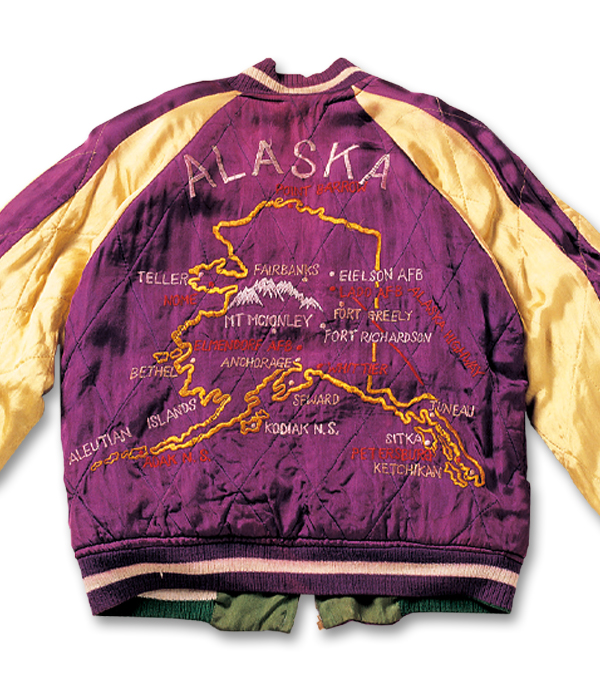
| Alaska | Late 1950s; “49TH STATE” means 1959 or later | Map, polar bear, dog sled, bases, 49TH STATE | Strong |
| Hawaii | Mid-to-late 1950s documented examples | ALOHA HAWAII, islands, flowers, hula, ukulele | Strong |
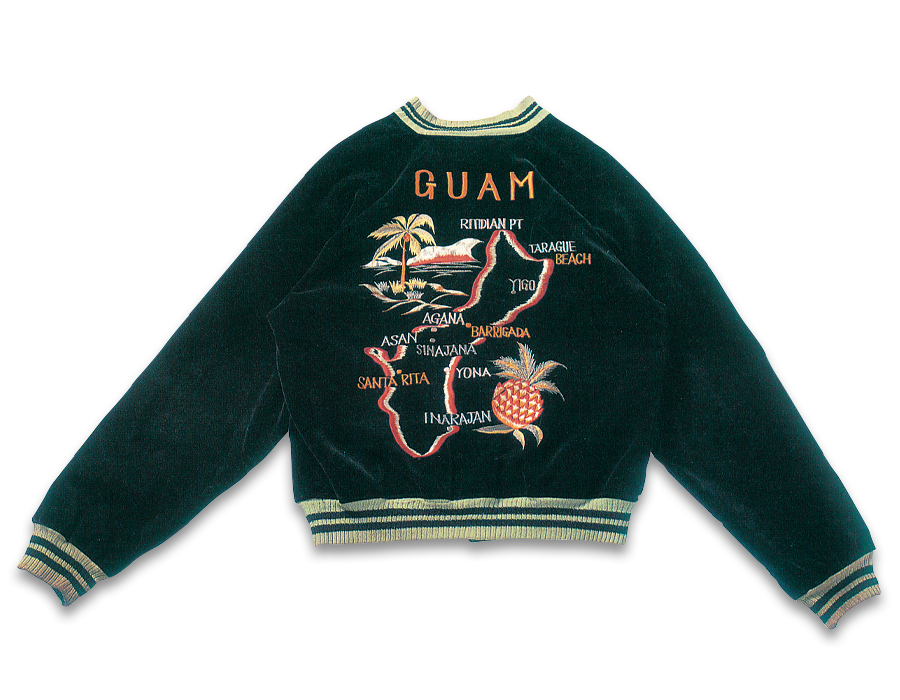
| Guam | Mid-to-late 1950s documented examples | GUAM, island map, bases, palms, pineapple | Strong |
| Eniwetok | U.S. nuclear-test period, 1948–1958 | ENIWETOK, mushroom cloud, operation names | Moderate |
| Greenland | After the 1951 agreement and Thule construction | GREENLAND, THULE, SONDRESTROM, NARSARSUAQ | Moderate |
Korea
A Korea map, the 38th parallel and cities such as SEOUL, PUSAN or PYONGYANG are more informative than a generic tiger. AAFES records exchanges supporting troops during the Korean War, including mobile facilities and a Seoul PX. Dates may record a serviceman’s tour rather than the jacket’s exact production year.
Panama
Some Panama examples use ordinary Japanese sukajan imagery with PANAMA added above it. In that situation the lettering establishes regional association, but the tiger itself does not date the posting. Zipper, fabric, ribs and construction carry more weight. Direct PX documentation remains limited for individual examples.
Iceland
Although military exchange history in Iceland predates the sukajan, the practical postwar starting point is the 1951 U.S.–Iceland defence agreement and the renewed operation of Keflavik facilities. ICE LAND, U.S. ARMED FORCES and KEFLAVIK can be compared with that history.
Alaska
Tailor Toyo’s archive documents Japanese-made jackets supplied for sale at Alaskan base exchanges in the late 1950s. “49TH STATE” provides a particularly useful lower boundary because Alaska became the 49th U.S. state in 1959.
Hawaii
Documented mid-to-late-1950s examples combine ALOHA HAWAII, island maps, hibiscus, hula or ukulele imagery. A reverse face may still use Japanese dragons or tigers. That combination makes sense for a Japanese-made item commissioned for a Pacific PX.
Guam
Tailor Toyo documents Japanese-made Guam jackets sold through base stores in the mid-to-late 1950s. GUAM, an island map, place and base names, palms and pineapples are useful clues. ANDERSEN lettering cannot predate the adoption of the Andersen Air Force Base name on 7 October 1949.
Eniwetok
The United States conducted 43 atmospheric nuclear tests at Eniwetok between 1948 and 1958. Jackets combining ENIWETOK, a mushroom cloud and an operation name should first be compared with that test period. An Operation Redwing report also records a local PX obtaining goods from Honolulu, the Far East and AAFES New York, evidence of a route for “Oriental type merchandise,” although it does not identify jackets specifically.
Greenland
THULE is a useful historical clue. Following the 1951 U.S.–Danish defence agreement, Thule Air Base was constructed during Operation Blue Jay from 1951 to 1953. A 1950s-style jacket centred on THULE therefore fits a post-1951 context, although an individual PX sales record is still needed for certainty.
Use motifs with construction evidence
Place names establish a historical window, not an exact factory date. Finish the analysis by comparing the zipper, body fabric, ribs, pockets, lining, embroidery technique and signs of repair. A later reproduction may faithfully reuse an early map, while a period jacket may have a replaced zipper.
Selected sources
- AAFES historical timeline
- U.S. Department of State: 1951 Iceland agreement
- Tailor Toyo: Alaska and 49th State design
- Andersen Air Force Base history
- U.S. Department of Energy: nuclear-testing legacy
- U.S. Space Force: Thule history
This article organises public historical evidence. It does not guarantee the production year, point of sale or authenticity of an individual jacket.