
“Souvenir jacket” is a broad term for a jacket made as a record of a posting, unit, journey or period of service. A Japanese sukajan is one form of souvenir jacket, but the two terms are not perfect synonyms.
| Name | Origin or role | Common visual clues |
|---|---|---|
| Souvenir jacket | Umbrella term | Place names, dates, maps, units and commemorative embroidery |
| Sukajan | Japan | Glossy or velveteen body, ribbed baseball-jacket shape, dragons, tigers, eagles or maps |
| Korean souvenir jacket | Korea | KOREA lettering, dragons, vivid thread colours; bodies vary widely |
| Vietnam jacket | Vietnam-war era | Maps, dates, tigers, black or camouflage bodies, often a shirt-like collar |
| German tour jacket | Postwar West Germany | GERMANY or city names, maps, flags and military patches |
Sukajan: the Japanese form
Sukajan developed in the postwar Japanese souvenir trade serving American servicemen. The best-known form uses a ribbed baseball-jacket body, a front zipper and bold embroidery. Many are reversible, although single-sided examples also exist.
Japanese-made PX jackets were also produced for places such as Hawaii, Alaska and Guam. The geography embroidered on a jacket therefore does not by itself establish where the garment was made.
Korean souvenir jackets
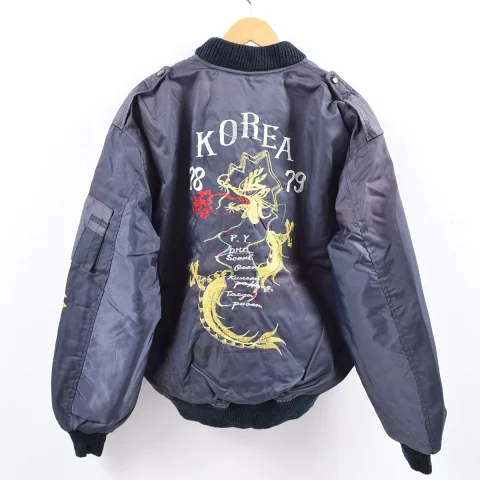
“Korijan” is a Japanese collectors’ nickname rather than a single official product category. It is often used for Korean souvenir jackets that differ visibly from Japanese sukajan.
Observed examples include MA-1-like bodies, wine or purple velveteen, hoods or fur trim, Gothic-style KOREA lettering and brightly coloured dragons. The category is not perfectly standardised, so body construction and provenance matter more than a nickname alone.
Vietnam jackets
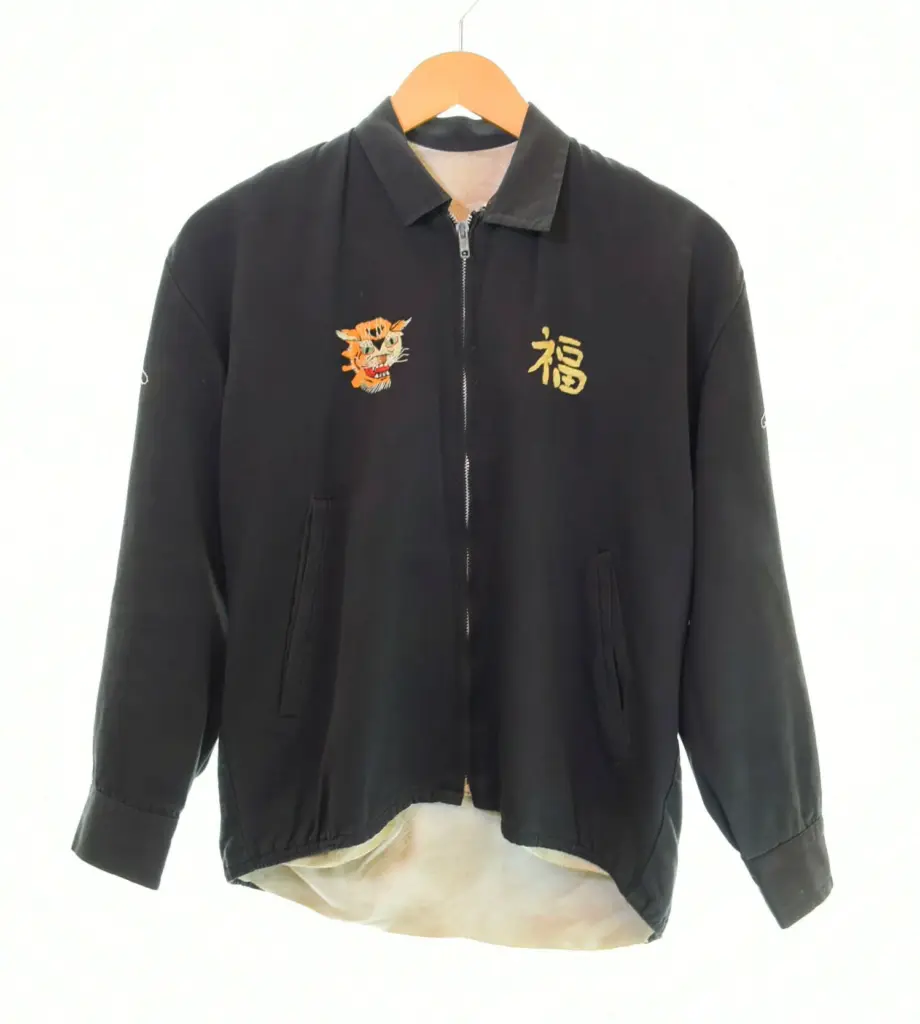
Vietnam souvenir jackets are associated with the 1960s and 1970s. Many use black cotton, rayon or camouflage material rather than the glossy baseball-jacket body most strongly associated with sukajan.
Common details include a soft-point collar, buttoned cuffs, a front zipper, an embroidered tiger, the character 福, maps, place names such as SAIGON, and dates marking a tour. Construction varies because these were not one centrally standardised garment.
German tour and souvenir jackets
American personnel stationed in West Germany also commissioned commemorative jackets. Examples may show GERMANY, WEST GERMANY, DEUTSCHLAND, city names, maps, flags and military patches. Satin stadium-jacket bodies and A-2-style forms both appear, and reversible construction is less central than it is in classic sukajan.
How to identify the category
Do not rely on one embroidered word. Compare five things:
- the overall body shape;
- fabric and lining;
- collar, cuffs and waistband;
- placement and style of embroidery;
- dates, place names, units and construction history.
A place name records part of the jacket’s story, but it may indicate a posting, a sales location or a requested design—not necessarily the factory that made it.