
A sukajan is an embroidered jacket that developed in postwar Japan as a souvenir for American servicemen. The name is generally understood as a shortened form of Yokosuka jumper. In English it is often called a Japanese souvenir jacket.
- Name: commonly derived from Yokosuka jumper
- Origin: postwar Japan and the U.S. military souvenir trade
- Typical details: embroidered dragons, tigers, eagles and maps; glossy fabric; ribbed baseball-jacket construction
- Not every example is identical: velveteen, quilting, reversible construction and regional motifs all occur
What does “sukajan” mean?
The most widely accepted explanation is that suka comes from Yokosuka and jan from the Japanese word janpā, or jumper. Yokosuka, south of Yokohama, became closely associated with the jackets because of its naval base and the postwar shops serving American personnel.
The term describes a historical clothing culture rather than one fixed modern specification. A sukajan may be reversible or single-sided, lightly constructed or quilted, made from acetate or velveteen, and embroidered with either Japanese imagery or the geography of another posting.
Why is it called a souvenir jacket?
Souvenir jacket is the broader English-language category. Servicemen commissioned or bought jackets as records of a posting, unit, journey or period of service. Place names, maps, dates and military references turned the garment into a wearable memento.
The sukajan is the Japanese branch of that wider tradition. Korea, Vietnam and West Germany produced other forms of souvenir or tour jacket, often with different bodies and embroidery styles.
How the sukajan began in Yokosuka
After the Second World War, shops around Yokosuka’s Dobuita Street served U.S. personnel stationed at the naval base. Local businesses sold ceramics, portraits, patches and other souvenirs. Embroidery shops could add names, ranks, units and Japanese motifs to clothing.
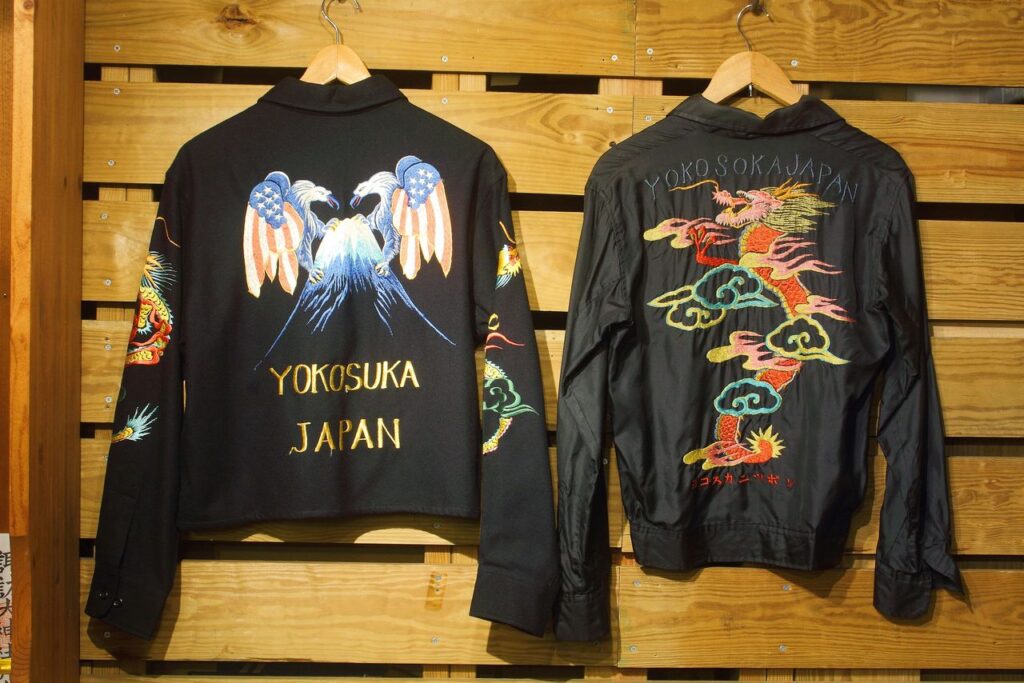
American military culture already included decorating personal equipment and clothing. In Japan, that practice met skilled local embroidery and imagery such as dragons, tigers, eagles and Mount Fuji. The earliest story is therefore not simply that one company invented a fashion item. It is a meeting of servicemen, souvenir shops and Japanese craftspeople.
From custom embroidery to a recognisable jacket
Minato Shokai, a predecessor of today’s Toyo Enterprise, helped turn the idea into a repeatable product. A baseball-jacket-like body was familiar to American buyers, while Japanese embroidery gave it the character of a souvenir from Asia.
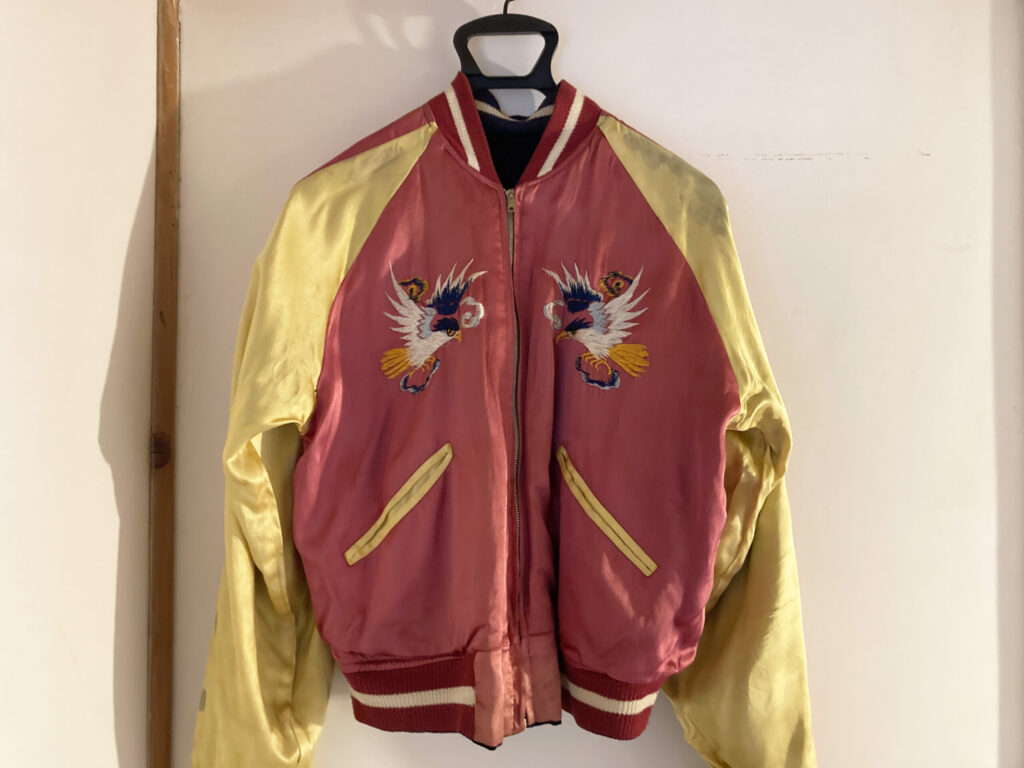
Embroidery production drew on the textile and embroidery industries of places such as Kiryu and Ashikaga. Acetate offered sheen and a silk-like appearance at a practical cost. Velveteen, padded quilting and reversible construction became other important variations.
PX sales and regional designs
PX means Post Exchange, a retail store serving military communities. As Japanese-made jackets entered PX and souvenir-shop networks, designs were created for postings beyond mainland Japan. Hawaii jackets may show islands, flowers or hula imagery; Alaska examples may feature polar bears, dog sleds and maps; Guam jackets may combine an island map with palms and pineapples.
This explains why a jacket can be Japanese-made without carrying a Japanese map. The place embroidered on the back may represent where it was sold or where its owner served, while the garment itself belongs to the Japanese souvenir-jacket production network.
From military souvenir to Japanese fashion
As the original military market changed, the sukajan became part of Japanese popular culture. Film and television helped associate it with rebellious characters. Later vintage booms brought renewed attention to surviving postwar pieces, while reproduction makers preserved historic patterns and construction.
Today the sukajan sits at the intersection of military history, regional memory, embroidery craft, street style and vintage collecting. That combination—not just the dragon on the back—is what makes it distinctive.
Key point
A sukajan is best understood as a Japanese souvenir jacket rooted in the postwar relationship between American servicemen and Japanese makers. To study one properly, look at the embroidery, place names, fabric, zipper, ribs, lining and historical context together.
Further reading: Nippon.com: Yokosuka and the Roots of Japan’s Dazzling Bomber Jackets · Yokosuka Museum of Art: Sukajan exhibition archive